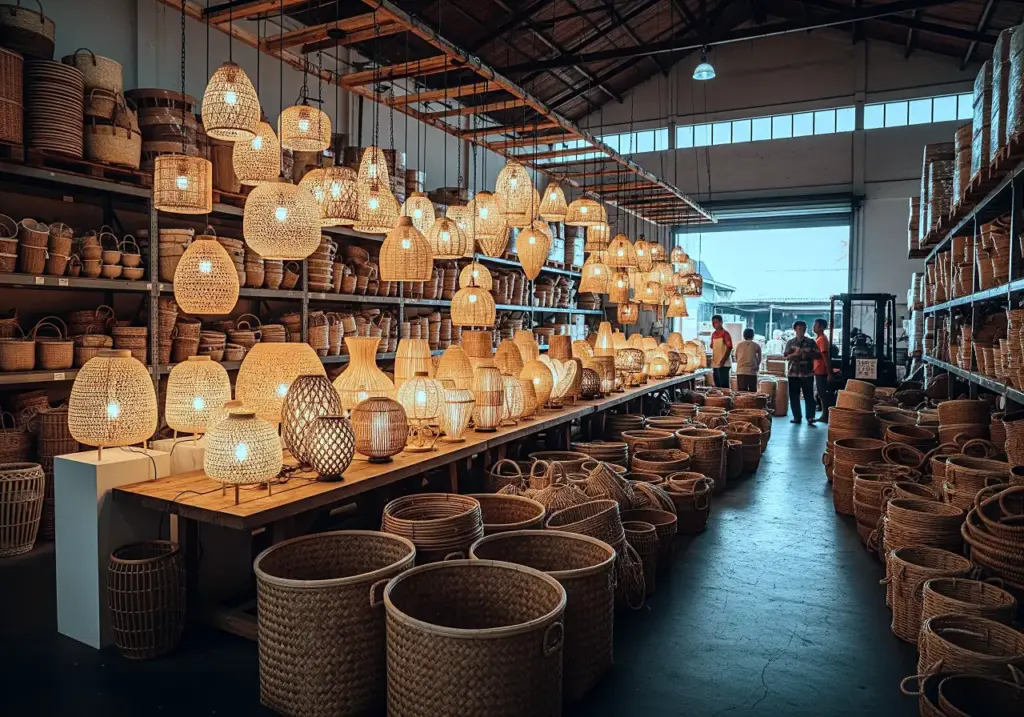
If you’re sourcing woven baskets wholesale from Indonesia for the first time, the process can feel opaque. Different suppliers quote different terms, factories vary wildly in quality, and shipping a container of natural fiber products across the world involves more moving parts than most buyers expect.
This guide walks you through the full process — from finding the right supplier to getting your order on a ship.
Indonesia is one of the world’s largest producers of natural fiber homewares. The country’s basket-weaving tradition spans generations, and today it supplies retailers and importers across the US, EU, Australia, and the Middle East with products made from rattan, seagrass, water hyacinth, pandanus, mendong, and banana fiber.
The advantages are real: lower labor costs than comparable suppliers in China or Vietnam, genuine artisan craft skills, and access to raw materials grown locally. A reputable Indonesian wholesale supplier can produce products to your spec, apply your private label, and ship FOB from Semarang or Surabaya.
The challenge is knowing how to navigate the sourcing process correctly.
Before reaching out to any supplier, get clear on what you actually need:
Having a reference image and target retail price point before your first conversation saves time on both sides.
There are three common routes:
Trade shows — Maison & Objet (Paris), NY NOW (New York), and the Jakarta International Expo (Inacraft) all feature Indonesian basket exporters. Meeting suppliers in person before committing is the most reliable method.
Online sourcing platforms — Alibaba and Global Sources list Indonesian basket manufacturers. Use these to get initial quotes and assess responsiveness, but always verify the factory directly before placing a substantial order.
Direct factory contact — Searching for B2B suppliers with a dedicated export operation (not just a reseller) gives you better pricing and more control over production. Look for suppliers who publish their MOQs, lead times, and FOB terms on their website — it signals a professional export setup.
When evaluating any supplier, ask for their export history, client references, and any third-party certifications relevant to your market (BSCI, SEDEX, or relevant phytosanitary compliance documentation).
A proper RFQ to an Indonesian basket supplier should include:
A professional supplier will respond with a per-unit price at your stated quantity, lead time from order confirmation to ex-factory, and available MOQ (minimum order quantity). Standard MOQs for Indonesian woven baskets range from 100 to 500 units per SKU, depending on complexity.
If you need private labeling or custom packaging, state this in the RFQ. Most established exporters offer OEM/private label as standard — but it affects lead time and may carry a minimum run requirement.
Never skip sampling. Natural fiber products vary significantly between batches, and photographs don’t capture weave tightness, material quality, or finish accuracy.
Request a pre-production sample (PPS) before placing a bulk order. You’ll typically pay a sample fee (often credited against your first order) and a courier cost. Evaluate:
If anything is off, communicate the correction clearly and request a revised sample. Reputable suppliers expect this.
Standard payment terms for Indonesian wholesale orders are TT 30/70: 30% deposit on order confirmation, 70% balance against the bill of lading before shipment. Some suppliers offer open account terms for established buyers.
Once you confirm samples, your supplier will issue a Proforma Invoice (PI). Review it carefully — it should specify unit prices, total quantity, incoterm, port of loading, payment terms, and production lead time.
Sign off on the PI and transfer your deposit to start production.
For most wholesale orders, you’ll ship via sea freight in a 20-foot or 40-foot container. Small initial orders may consolidate as LCL (less-than-container-load) through a freight forwarder.
Your supplier ships FOB from their nearest port — typically Semarang (Central Java), Surabaya (East Java), or Tanjung Priok (Jakarta). From there, transit times are approximately:
Ensure your freight forwarder is briefed on the product category. Natural fiber products may require phytosanitary certificates (Indonesia issues these for export) and fumigation documentation. US importers should be aware of Lacey Act documentation requirements; EU buyers should confirm EUDR compliance where applicable.
The difference between a smooth wholesale relationship and a frustrating one usually comes down to a few factors:
Indonesia’s basket-weaving industry is mature and export-oriented. Partnering with a supplier who treats wholesale buyers as long-term partners — not one-off transactions — makes all the difference.
Eco Bhavana is a B2B wholesale supplier of handwoven natural fiber products based in Yogyakarta, Indonesia. We work with importers, retailers, and interior wholesalers across the US, EU, Australia, and the Middle East — supplying rattan, seagrass, water hyacinth, pandanus, and mendong baskets, hampers, and home accessories with full OEM/private label capability.


Tired of mass-produced goods? Partner with PT. Mitra Eco Bhavana for a unique wholesale advantage, offering sustainable, handcrafted solutions like woven laundry baskets and stunning woven hanging lamps that stand out.
Handwoven natural fiber products from Indonesia — factory-direct wholesale for global retailers, interior designers, and hospitality buyers.